The Annual Conference had a lovely banquet at the Sheraton Westport Chalet, with St. Louis Post-Dispatch book editor Jane Henderson as the speaker. Her talk, "No Need to Send a Condom and Other Tips on Approaching the News Media," featured a visual aid of the condom in question, along with a lot of useful information about how authors can advance their message with the media. Thanks to Jane for her talk!
2013 MWG Conference Notes
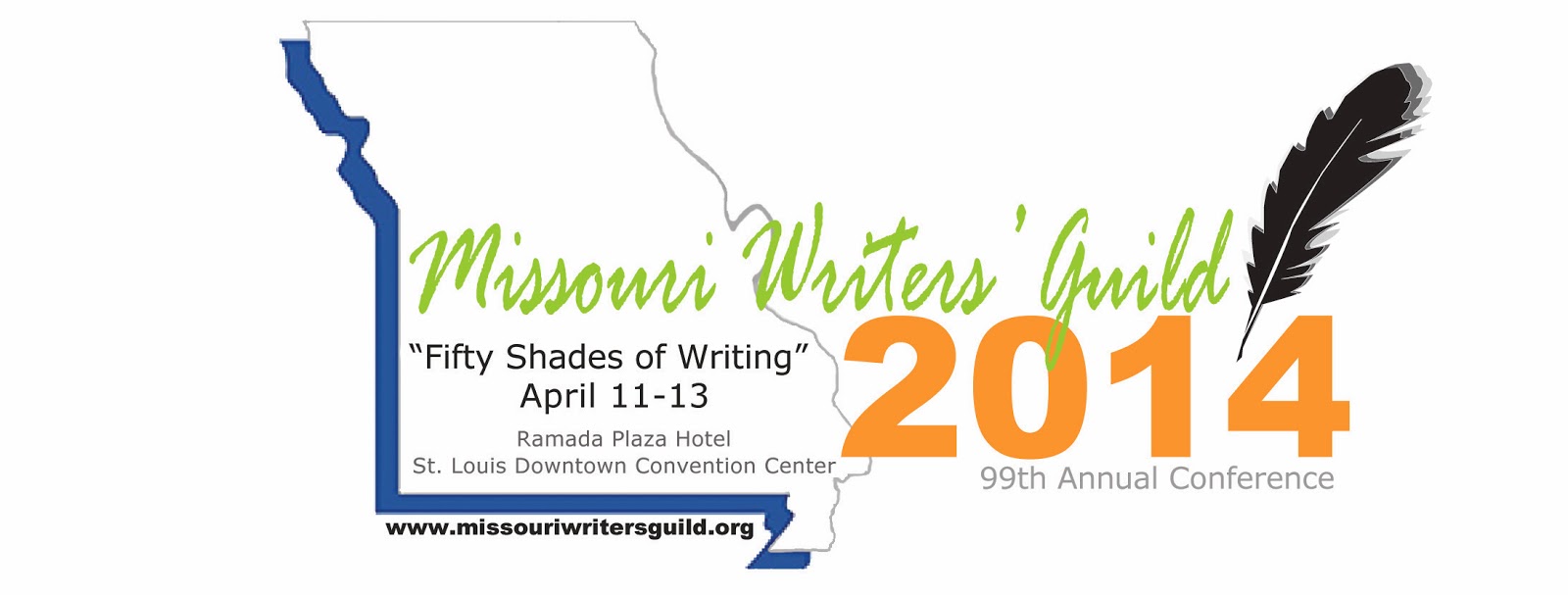
Planning is underway for the 2013 Missouri Writers' Guild Conference. Stay tuned for information and share our link with your friends.
Monday, April 22, 2013
Robin Tidwell, Rocking Horse Publishing, Coming to the Conference!
Please help me welcome, Robin Tidwell, to our blog and April 2013 conference! Robin is the author of REDUCED and REUSED, and lives in the St. Louis area with her husband, Dennis, and their youngest son. She has a rather eclectic educational background, and finally finished her B.A. in interdisciplinary studies. She has held a plethora of jobs, appointments, and volunteer positions, and tries very hard to make it through one week at a time without a crisis. Robin and Dennis are the owners of All on the Same Page Bookstore and Rocking Horse Publishing.
MWG: Welcome, Robin, to the MWG conference blog! Why did you found Rocking Horse Publishing and when?
Robin: I self-published my first book, Reduced, in late August 2012; made a few mistakes; decided to re-do the formatting; and was working on my second book, Reused, when I thought, Hey, why not just start a publishing house? I was already doing book consulting and marketing seminars, etc., so it seemed like a natural fit, especially since we’d opened a bookstore in October 2011.
MWG: I love that--you just thought, WHY NOT START A PUBLISHING HOUSE!! What kind of submissions do you take?
Robin: Right now, we accept all types of fiction and limited nonfiction. So far we’ve done dystopian, romance, and children’s. We have two more children’s and another romance in the works--and a cookbook, humor, and two science fiction (one YA) coming up this year.
MWG: Awesome--that's a great line-up. What will you be doing at the MWG conference this weekend?
Robin: There are several sessions that I’d like to catch, and of course, I’ll be selling my books. I’m also anxious to meet authors whom I’ve only met online so far, and to see some “old” friends again. And then, too, I’ll be taking pitches for RHP.
MWG: So, you'll be around AND taking formal pitches. So, MWG conference-goers, here's a question that we should all pay attention to: What makes you love a submission? (Do you have other editors, too?)
Robin: I have to like the story, and I have to believe it’s relevant – in other words, can I sell it? After that, it has to be good writing. That’s hard to define; but as a lifelong reader and writer, I know if something is good or not. And yes, we have a fantastic editor!
MWG: On the flip side, what makes you reject a submission?
Robin: I hate rejecting any manuscript; and truthfully, I haven’t outright rejected many – but I do make notes and if I don’t think it’s quite “right,” I send it back to the author with suggestions for improvement. And I invite him to resubmit after the changes are made. Of course, when poor spelling and grammar are in the query letter itself, I hesitate to even read the manuscript; I try to send back words of encouragement, but have to be firm as well.
MWG: Yes, we are always hearing how important it is to proofread! Tell us a bit about you as an author!
Robin: I’ve done a fair amount of writing over the years, especially for online publications and websites, and have been working on my “great American novel” for a number of years. Woke up one day after an awesome dream and began writing Reduced. It took me six months, on and off, and I queried half a dozen or so agents. I got a few “no thanks” responses, and several simply didn’t bother to respond. Then I got a contract offer from a small press… I turned it down. It was a decent contract, very exciting to get that e-mail, but I realized that the things they were going to do for me weren’t enough to justify handing over most of the earnings. Besides, I’m not known for my patient nature, and waiting until just past the holiday sales for a print copy wasn’t going to work for me. I wrote Reused in about six weeks, because I was kind of procrastinating – in fact, that’s when I founded RHP, in a moment of boredom combined with a dearth of ideas for that sequel. I’ve been told it’s a little better than Reduced, but I doubt it has to do with the speed of writing! I’m currently at work on the third in the series, Recycled. It’s due out the end of May/first of June.
MWG: I love your spirit and passion! Anything else you want to add?
Robin: While I have little patience myself, I’d like to counsel authors to have at least a tiny bit of it, especially when submitting to a small press. We’re small, after all; and no, we don’t have some of the resources that the big publishers do – and that includes personnel. A month or so is not long; and if you e-mail me within a couple weeks to tell me someone else is interested and ask when I’ll be getting back to you, I’m mostly likely to wish you good luck and file your manuscript under “no.”
MWG: Thank you, Robin! We look forward to visiting with you at the conference.
Interview conducted by Margo L. Dill. To find out more about Margo and her middle-grade historical-fiction novel, FINDING MY PLACE, please visit: http://margodill.com/blog/.
MWG: Welcome, Robin, to the MWG conference blog! Why did you found Rocking Horse Publishing and when?
Robin: I self-published my first book, Reduced, in late August 2012; made a few mistakes; decided to re-do the formatting; and was working on my second book, Reused, when I thought, Hey, why not just start a publishing house? I was already doing book consulting and marketing seminars, etc., so it seemed like a natural fit, especially since we’d opened a bookstore in October 2011.
MWG: I love that--you just thought, WHY NOT START A PUBLISHING HOUSE!! What kind of submissions do you take?
Robin: Right now, we accept all types of fiction and limited nonfiction. So far we’ve done dystopian, romance, and children’s. We have two more children’s and another romance in the works--and a cookbook, humor, and two science fiction (one YA) coming up this year.
MWG: Awesome--that's a great line-up. What will you be doing at the MWG conference this weekend?
Robin: There are several sessions that I’d like to catch, and of course, I’ll be selling my books. I’m also anxious to meet authors whom I’ve only met online so far, and to see some “old” friends again. And then, too, I’ll be taking pitches for RHP.
MWG: So, you'll be around AND taking formal pitches. So, MWG conference-goers, here's a question that we should all pay attention to: What makes you love a submission? (Do you have other editors, too?)
Robin: I have to like the story, and I have to believe it’s relevant – in other words, can I sell it? After that, it has to be good writing. That’s hard to define; but as a lifelong reader and writer, I know if something is good or not. And yes, we have a fantastic editor!
MWG: On the flip side, what makes you reject a submission?
Robin: I hate rejecting any manuscript; and truthfully, I haven’t outright rejected many – but I do make notes and if I don’t think it’s quite “right,” I send it back to the author with suggestions for improvement. And I invite him to resubmit after the changes are made. Of course, when poor spelling and grammar are in the query letter itself, I hesitate to even read the manuscript; I try to send back words of encouragement, but have to be firm as well.
MWG: Yes, we are always hearing how important it is to proofread! Tell us a bit about you as an author!
Robin: I’ve done a fair amount of writing over the years, especially for online publications and websites, and have been working on my “great American novel” for a number of years. Woke up one day after an awesome dream and began writing Reduced. It took me six months, on and off, and I queried half a dozen or so agents. I got a few “no thanks” responses, and several simply didn’t bother to respond. Then I got a contract offer from a small press… I turned it down. It was a decent contract, very exciting to get that e-mail, but I realized that the things they were going to do for me weren’t enough to justify handing over most of the earnings. Besides, I’m not known for my patient nature, and waiting until just past the holiday sales for a print copy wasn’t going to work for me. I wrote Reused in about six weeks, because I was kind of procrastinating – in fact, that’s when I founded RHP, in a moment of boredom combined with a dearth of ideas for that sequel. I’ve been told it’s a little better than Reduced, but I doubt it has to do with the speed of writing! I’m currently at work on the third in the series, Recycled. It’s due out the end of May/first of June.
MWG: I love your spirit and passion! Anything else you want to add?
Robin: While I have little patience myself, I’d like to counsel authors to have at least a tiny bit of it, especially when submitting to a small press. We’re small, after all; and no, we don’t have some of the resources that the big publishers do – and that includes personnel. A month or so is not long; and if you e-mail me within a couple weeks to tell me someone else is interested and ask when I’ll be getting back to you, I’m mostly likely to wish you good luck and file your manuscript under “no.”
MWG: Thank you, Robin! We look forward to visiting with you at the conference.
Interview conducted by Margo L. Dill. To find out more about Margo and her middle-grade historical-fiction novel, FINDING MY PLACE, please visit: http://margodill.com/blog/.
Wednesday, April 10, 2013
If This Doesn't Pique Your Curiosity, Nothing Will . . .
Jane Henderson's banquet speech for Saturday night:
"No Need To Send a Condom and Other Tips on Approaching News Media"
Some things (major and minor) a newspaper editor takes into consideration when choosing books for review.
Jane is the book editor for the St. Louis Post-Dispatch.
It's not too late to register for the conference! We are anticipating a great group of people at this year's event.
"No Need To Send a Condom and Other Tips on Approaching News Media"
Some things (major and minor) a newspaper editor takes into consideration when choosing books for review.
Jane is the book editor for the St. Louis Post-Dispatch.
It's not too late to register for the conference! We are anticipating a great group of people at this year's event.
Monday, April 8, 2013
Sarah Fine, YA Author, Coming to the MWG Conference!
Sarah Fine is a child psychologist and author. Her debut YA urban fantasy novel, SANCTUM, the first installment in the Guards of the Shadowlands series, was published in Fall 2012 by Amazon Children’s Publishing, and the sequel, FRACTURED, will be released in October 2013. Her YA gothic novel, FACTORY GHOST, will be published by McElderry/Simon & Schuster in summer 2014. She also co-writes (with Walter Jury) YA thrillers under the name S.E. Fine; SCAN will be published in May 2014 by Putnam/Penguin. On the web, she can be found at www.sarahfinebooks.com, on Twitter (@finesarah), and at http://thestrangestsituation.blogspot.com/, where she blogs about psychology and YA.
MWG: Sarah, welcome to the Missouri Writers Guild conference blog. But better yet, welcome to the conference! What will you be speaking about?
Sarah: Thank you! I’ll be speaking about several things, actually. One of the sessions is about how writers can develop thinking habits that help when dealing with writer’s block and rejection, another is about writing teen characters, and then I’m offering a master class about how to “properly” traumatize characters.
MWG: I love that--properly "traumatize" characters! Who is the perfect audience for your workshop?
Sarah: I think all of them are appropriate for writers at any level of experience, because I’ll be focusing on the intersection of psychology and storytelling.
MWG: Sounds fascinating! You have great experience in the YA genre. In your opinion, what makes a great YA novel?
Sarah: A story that captures the universal experience of that time of life: the struggle to develop independence; the all-encompassing emotion; the rawness of propelling events, making decisions, and accepting major responsibility for the first time in one’s life, most likely before feeling completely ready to do that. No matter what situation or genre within YA, a great young adult story is a distillation of that life experience that resonates with teens—and with adults who remember what that was like.
MWG: What are one or two mistakes you find new writers making when writing YA?
Sarah: One would be trying to provide a life lesson or “teach” the teen reader—if that’s why you’re writing YA, you should probably stop. That doesn’t mean you can’t have a strong point of view, but the number one goal should always be to tell a good, absorbing, genuine story. And I suppose another mistake would be failing to listen to teens talk; dialogue is tricky to begin with; but if you’re an adult writing YA, you’ll do well to sit in a coffee shop or mall and just listen.
MWG: Great advice! Tell us a little about your latest YA book! Where can people find copies? Will you be selling any at the conference?
Sarah: Sanctum is the story of a girl who sneaks into hell—a dark, walled city—to rescue the soul of her best friend, a mission greatly complicated when she’s captured by the Captain of the city’s Guard. It was published in October of 2012 (Skyscape/Amazon Children’s Publishing); and the sequel, Fractured, comes out on October 29th of this year. I believe I’ll be at the author signing on Saturday with copies of Sanctum.
MWG: Terrific and sounds like a captivating plot! You also have a blog. How important is it for authors to have a blog?
Sarah: I don’t claim to be an expert in this kind of thing (though my agent, Kathleen Ortiz, certainly is), but how important it is to have a blog depends on your goal. A blog is helpful in connecting to the writing community, deriving support, and learning; but I don’t think it’s necessarily important in getting an agent or finding publishing success in the world of fiction. Most of my blog audience is other writers, not readers. However, I do think it’s crucial that authors have some kind of web presence; but these days, there are so many ways to do that—a website, Twitter, tumblr, Pinterest, Facebook, etc.. I’m most active on Twitter these days, but also have a tumblr site for my series. Authors should choose the medium(s) in which they’re most natural and comfortable, and simply interact and participate.
MWG: Thank you so much for your time. Is there anything else you'd like to add?
Sarah: I’m looking forward to meeting folks at the conference!
For more information and to register for the conference (discounted price before 4/15/2013), go to: http://www.missouriwritersguild.org/Conference2013v9/index.htm
interview by Margo L. Dill, author of Finding My Place: One Girl's Strength at Vicksburg.
MWG: Sarah, welcome to the Missouri Writers Guild conference blog. But better yet, welcome to the conference! What will you be speaking about?
Sarah: Thank you! I’ll be speaking about several things, actually. One of the sessions is about how writers can develop thinking habits that help when dealing with writer’s block and rejection, another is about writing teen characters, and then I’m offering a master class about how to “properly” traumatize characters.
MWG: I love that--properly "traumatize" characters! Who is the perfect audience for your workshop?
Sarah: I think all of them are appropriate for writers at any level of experience, because I’ll be focusing on the intersection of psychology and storytelling.
MWG: Sounds fascinating! You have great experience in the YA genre. In your opinion, what makes a great YA novel?
Sarah: A story that captures the universal experience of that time of life: the struggle to develop independence; the all-encompassing emotion; the rawness of propelling events, making decisions, and accepting major responsibility for the first time in one’s life, most likely before feeling completely ready to do that. No matter what situation or genre within YA, a great young adult story is a distillation of that life experience that resonates with teens—and with adults who remember what that was like.
MWG: What are one or two mistakes you find new writers making when writing YA?
Sarah: One would be trying to provide a life lesson or “teach” the teen reader—if that’s why you’re writing YA, you should probably stop. That doesn’t mean you can’t have a strong point of view, but the number one goal should always be to tell a good, absorbing, genuine story. And I suppose another mistake would be failing to listen to teens talk; dialogue is tricky to begin with; but if you’re an adult writing YA, you’ll do well to sit in a coffee shop or mall and just listen.
MWG: Great advice! Tell us a little about your latest YA book! Where can people find copies? Will you be selling any at the conference?
Sarah: Sanctum is the story of a girl who sneaks into hell—a dark, walled city—to rescue the soul of her best friend, a mission greatly complicated when she’s captured by the Captain of the city’s Guard. It was published in October of 2012 (Skyscape/Amazon Children’s Publishing); and the sequel, Fractured, comes out on October 29th of this year. I believe I’ll be at the author signing on Saturday with copies of Sanctum.
MWG: Terrific and sounds like a captivating plot! You also have a blog. How important is it for authors to have a blog?
Sarah: I don’t claim to be an expert in this kind of thing (though my agent, Kathleen Ortiz, certainly is), but how important it is to have a blog depends on your goal. A blog is helpful in connecting to the writing community, deriving support, and learning; but I don’t think it’s necessarily important in getting an agent or finding publishing success in the world of fiction. Most of my blog audience is other writers, not readers. However, I do think it’s crucial that authors have some kind of web presence; but these days, there are so many ways to do that—a website, Twitter, tumblr, Pinterest, Facebook, etc.. I’m most active on Twitter these days, but also have a tumblr site for my series. Authors should choose the medium(s) in which they’re most natural and comfortable, and simply interact and participate.
MWG: Thank you so much for your time. Is there anything else you'd like to add?
Sarah: I’m looking forward to meeting folks at the conference!
For more information and to register for the conference (discounted price before 4/15/2013), go to: http://www.missouriwritersguild.org/Conference2013v9/index.htm
interview by Margo L. Dill, author of Finding My Place: One Girl's Strength at Vicksburg.
Saturday, March 16, 2013
Janet Cannon, Speaker: Writers Need to Use Technology to their Advantage
Janet Cannon has been a technology instructor for Cape Girardeau public schools for the past eight years. She teaches fifth and sixth grade computer lab at Cape Middle School, adult computer application classes at the Career and Technology Center, and is one of the technology trainers for district personnel. She is the editor for the middle school newsletter, the Missouri Writers’ Guild newsletter, and in her spare time teaches origami, duct tape projects, and writes compositions for the instrumental and drumming ensemble at her school. Her publishing credits include a technical manual, several short stories, and quite a few pieces of Twitter fiction. Her masters is in English with an emphasis in technology integration, and she is proud of the fact that, “Do you want fries with that?” has never been part of her working vocabulary. She’s been happily married for 15 years, and her hobbies include cooking, running, needlework, and solving the Rubic's cube blindfolded.
MWG: Hi Janet, welcome to the conference blog. You are going to be presenting about how technology can help us to become brilliant writers! (Smiles) So, how does technology play a part in your own writing?
Janet: Like most writers, I began my writing obsession with good ol' pencil and paper. I’d doodle, write a draft, revise, (rip into shreds), re-write, revise, revise, edit, edit, etc. There's nothing wrong with that. And I still do some drafting, re-writing, or outlining by hand. However, for me and a lot of digital natives--those who grew up using computers--typing and using digital media to express ourselves is a faster and more efficient way to get our point across. Each program I work with helps organize and visualize my projects in a way pencil and paper can't accomplish (for me). For example, with One Note, I can keep track of all of my contest submissions, character notes, and research information, just as if I had a three-ring binder of the same information, but it’s easier to manipulate than a physical binder of paper. As a visual learner and writer, I can find a picture that inspires me, add it to my document, then use that to help me fill in the details when my brain is tired. Technology also helps mitigate my (many, many) mistakes! After so many erasures and scratch-outs on paper, I get frustrated with the mess, especially when I erase through the paper and tear it! Digital formats always give you a blank slate, a clean past, so you can focus on the continent of your piece rather than how messy the draft is.
MWG: You are going to show writers how to use Word and PowerPoint to the fullest extent. Give us a little preview here.
Janet: Word is such a powerful tool. No matter what genre you're writing, Word has some technological magic you probably haven't seen. If you need to cite your sources, it has a built-in citation builder in pretty much any format you want. Do you want every document you open to have the same size font, the same spacing, the same tab settings, etc.? There's an option to set that. Do you know how to format headers and footers? Find and replace text? Resize your paper? Set uneven margins, manipulate your rulers, insert hyperlinks, insert cover pages or create an outline without having to type the Roman numerals or letters? Word can do that and a lot more. PowerPoint is universally used for presentations, but it is one of the most powerful storyboarding tools out there. Put one picture or idea per slide, then re-order them and add details until they are in perfect order. Bam! Your outline is ready to go. You can even add more details and create your synopsis. For those writing children’s books, it’s the perfect layout tool with your illustrations (and text if you’re using any). I'll even take questions from the audience on writing "problems" they have and see if I can come up with a software solution.
MWG: Oh my gosh, I love the idea of Power Point for picture books. I never thought of that. Brilliant! If time permits, you will show them about Publisher, too. For those of us who don't know much more than Word, can you tell us a little about Publisher? Who makes it and what writers need it?
Janet: Publisher is also a Microsoft product. It's a desktop publishing program that's a lot easier to use than Adobe Photoshop and more powerful than a lot of "greeting card" software programs that are out there. You can create newsletters, business cards, greeting cards, banners, etc. AND books of any size. What makes Publisher different than Word is that the platform makes handling graphics much easier than in Word. If you want to self-publish a work containing photos or pictures and don't have the time or resources to learn Photoshop or Photoshop Elements, Publisher is a good alternative. I could spend an entire session on layout and design for self-publishing in Publisher, but I’ll leave that for another presentation. Maybe one of the Chapters will want to see that at one of their meetings.
MWG: It sounds like something I would be interested in seeing. We should set that up with Saturday Writers! So, who should come to your workshop at the conference?
Janet: Anyone who wants to know how to use their computer more efficiently in their writing. Genre doesn't matter. Level of computer experience doesn't matter. I'm used to having all levels of experience in my classroom. There are no stupid questions; and even if you already know a lot, I guarantee I can teach you one thing you don't know. Come with questions. I love the challenge of trying to solve problems other people have with their writing/software issues.
MWG: Sounds awesome and very practical, too! Tell us a little about what you are currently working on!
Janet: "The novel." Isn't everyone? Strangely enough, though, right now I'm really hot in the Twitter fiction market (a story of 140 characters of text or less), which is crazy, because that's more of a poet's genre, and I'm NOT a poet. I had five or six published in December. It pays nothing. Literally. But at the end of the school day, that's about all my brain will produce. And as I writer, I want to write SOMETHING every day to keep the creative juices flowing. I also write short stories and flash fiction. Fantasy/urban fantasy/science fiction are my usual genres, but I don’t limit myself to wizards, werebeasts, and computers. I try to write in different genres to stretch my skills. I enter a lot of short story contests just to get some credits under my belt and on my cover letter. And after I publish my first novel, I’ve decided to scan all my rejection letters into the computer, print them on brightly-colored fabric, make a quilt and sit on it. Every night. And smile as I write volume two.
MWG: You will have to put the rejection quilt idea on Pinterest! Anything else you'd like to add?
Janet: We live in an age where you almost CAN’T be a successful writer without a computer. I may not have all the answers, but hopefully I can help with a few ideas that will improve your relationship with your computer, so it’s more of a partnership than a show-down at the O. K. Corral every time you boot it up. So come to my session and be prepared to enjoy learning. I’m not like those stodgy, old professors you’re used to! ;-)
MWG: See you soon, Janet! We're looking forward to a great conference and your workshop!
To register for the MWG conference and see amazing speakers like Janet, go to this link: http://www.missouriwritersguild.org/Conference2013v9/index.htm
MWG: Hi Janet, welcome to the conference blog. You are going to be presenting about how technology can help us to become brilliant writers! (Smiles) So, how does technology play a part in your own writing?
Janet: Like most writers, I began my writing obsession with good ol' pencil and paper. I’d doodle, write a draft, revise, (rip into shreds), re-write, revise, revise, edit, edit, etc. There's nothing wrong with that. And I still do some drafting, re-writing, or outlining by hand. However, for me and a lot of digital natives--those who grew up using computers--typing and using digital media to express ourselves is a faster and more efficient way to get our point across. Each program I work with helps organize and visualize my projects in a way pencil and paper can't accomplish (for me). For example, with One Note, I can keep track of all of my contest submissions, character notes, and research information, just as if I had a three-ring binder of the same information, but it’s easier to manipulate than a physical binder of paper. As a visual learner and writer, I can find a picture that inspires me, add it to my document, then use that to help me fill in the details when my brain is tired. Technology also helps mitigate my (many, many) mistakes! After so many erasures and scratch-outs on paper, I get frustrated with the mess, especially when I erase through the paper and tear it! Digital formats always give you a blank slate, a clean past, so you can focus on the continent of your piece rather than how messy the draft is.
MWG: You are going to show writers how to use Word and PowerPoint to the fullest extent. Give us a little preview here.
Janet: Word is such a powerful tool. No matter what genre you're writing, Word has some technological magic you probably haven't seen. If you need to cite your sources, it has a built-in citation builder in pretty much any format you want. Do you want every document you open to have the same size font, the same spacing, the same tab settings, etc.? There's an option to set that. Do you know how to format headers and footers? Find and replace text? Resize your paper? Set uneven margins, manipulate your rulers, insert hyperlinks, insert cover pages or create an outline without having to type the Roman numerals or letters? Word can do that and a lot more. PowerPoint is universally used for presentations, but it is one of the most powerful storyboarding tools out there. Put one picture or idea per slide, then re-order them and add details until they are in perfect order. Bam! Your outline is ready to go. You can even add more details and create your synopsis. For those writing children’s books, it’s the perfect layout tool with your illustrations (and text if you’re using any). I'll even take questions from the audience on writing "problems" they have and see if I can come up with a software solution.
MWG: Oh my gosh, I love the idea of Power Point for picture books. I never thought of that. Brilliant! If time permits, you will show them about Publisher, too. For those of us who don't know much more than Word, can you tell us a little about Publisher? Who makes it and what writers need it?
Janet: Publisher is also a Microsoft product. It's a desktop publishing program that's a lot easier to use than Adobe Photoshop and more powerful than a lot of "greeting card" software programs that are out there. You can create newsletters, business cards, greeting cards, banners, etc. AND books of any size. What makes Publisher different than Word is that the platform makes handling graphics much easier than in Word. If you want to self-publish a work containing photos or pictures and don't have the time or resources to learn Photoshop or Photoshop Elements, Publisher is a good alternative. I could spend an entire session on layout and design for self-publishing in Publisher, but I’ll leave that for another presentation. Maybe one of the Chapters will want to see that at one of their meetings.
MWG: It sounds like something I would be interested in seeing. We should set that up with Saturday Writers! So, who should come to your workshop at the conference?
Janet: Anyone who wants to know how to use their computer more efficiently in their writing. Genre doesn't matter. Level of computer experience doesn't matter. I'm used to having all levels of experience in my classroom. There are no stupid questions; and even if you already know a lot, I guarantee I can teach you one thing you don't know. Come with questions. I love the challenge of trying to solve problems other people have with their writing/software issues.
MWG: Sounds awesome and very practical, too! Tell us a little about what you are currently working on!
Janet: "The novel." Isn't everyone? Strangely enough, though, right now I'm really hot in the Twitter fiction market (a story of 140 characters of text or less), which is crazy, because that's more of a poet's genre, and I'm NOT a poet. I had five or six published in December. It pays nothing. Literally. But at the end of the school day, that's about all my brain will produce. And as I writer, I want to write SOMETHING every day to keep the creative juices flowing. I also write short stories and flash fiction. Fantasy/urban fantasy/science fiction are my usual genres, but I don’t limit myself to wizards, werebeasts, and computers. I try to write in different genres to stretch my skills. I enter a lot of short story contests just to get some credits under my belt and on my cover letter. And after I publish my first novel, I’ve decided to scan all my rejection letters into the computer, print them on brightly-colored fabric, make a quilt and sit on it. Every night. And smile as I write volume two.
MWG: You will have to put the rejection quilt idea on Pinterest! Anything else you'd like to add?
Janet: We live in an age where you almost CAN’T be a successful writer without a computer. I may not have all the answers, but hopefully I can help with a few ideas that will improve your relationship with your computer, so it’s more of a partnership than a show-down at the O. K. Corral every time you boot it up. So come to my session and be prepared to enjoy learning. I’m not like those stodgy, old professors you’re used to! ;-)
MWG: See you soon, Janet! We're looking forward to a great conference and your workshop!
To register for the MWG conference and see amazing speakers like Janet, go to this link: http://www.missouriwritersguild.org/Conference2013v9/index.htm
Friday, March 8, 2013
Blank Slate Press at the MWG Conference
![]() |
| Kristina |
Jennifer has taught creative writing at the university level and has worked as a reading and writing instructor, tutor and editor at various community-based organizations and privately. Her work appears in Night Train Magazine and The Los Angeles Review; she has been honored in the Million Writers Award, storySouth’s Best of the Net, is the recipient of The Jefferson Fellowship from the Santa Barbara Writers Conference, and was invited to attend both the 2012 Tin House Writer’s Workshop and the 2012 Community of Writers at Squaw Valley. Currently, she is at work on her second novel, Predicting Gravity, and is in the process of securing a publisher for her first novel, What If It’s Empty.
Amira has served as an assistant editor and has read and evaluated Blank Slate Press submissions since the press was founded. She has also worked at various wineries in Oregon, has lived and worked in the wine industry in France and is approaching fluency in French. She currently works part-time for a wine distributorship in St. Louis.
MWG: Hi Kristina! Welcome to the conference blog. Please share with us a bit about Blank Slate Press.
Kristina: Blank Slate Press was founded in 2010 to discover, nurture, publish and promote new voices from the greater St. Louis region and beyond. We’ve published six books—five fiction and one memoir. Out of those, we’ve had two award winners and one “runner up” to a major award. We currently have four more books we’ve committed to that are in the pipeline, three that are part of a crime series based in St. Louis and one that is a sequel to one of our earlier books.
MWG: It sounds like you've had GREAT success! Are you currently looking for submissions? Will you be taking pitches at the MWG conference?
![]() |
| Jennifer |
MWG: I've personally read Steve's book, and it is wonderful! What really wows you about a manuscript submission or a pitch?
Kristina: To be frank, I get excited about a lot of story ideas because I enjoy many different genres, but there are two things that wow me—a concise, powerful pitch and a first chapter that immediately draws me in and makes me want to keep reading. Authors should pay an inordinate amount of attention to their first paragraph, even their first sentence.
MWG: Yes, that is so true, and sometimes, that first sentence/paragraph seems harder than writing the whole book! Anything that turns you off almost immediately?
Kristina: An author who doesn’t do his homework and who has no idea how publishing works. The industry is changing and I’m still learning—but if a writer wants to be treated like a professional in the industry, she must act like a professional and that means doing the necessary homework, so she understands the basics of how a book goes from an idea in the author’s head to a book in the reader’s hands.
MWG: Oh, so true! That's one of the reasons why we are doing these blog posts--to make homework for the conference attendees a little bit easier! What are you most looking forward to at the MWG conference?
Kristina: Our editors are looking forward to meeting authors, and we’re always looking forward to learning something new.
MWG: Tell us a little about yourself in closing--how long have you been in publishing and share anything else you'd like us to know!
![]() |
| Amira |
MWG: Thank you for your time, Kristina! That all sounds amazing, and we will miss you at the MWG conference, but look forward to visiting with Jennifer and Amira!
Interview conducted by Margo L. Dill, author of Finding My Place: One Girl's Strength at Vicksburg.
Subscribe to:
Posts (Atom)